Tuesday, 6 September 2011

Week 7

Scenario Workshop 1
In this weeks class we divided up into our specific O-B-S groups. As one team member was absent that week I naturally took his place in the Scenario workshop. In this workshop we were taught how to fully breakdown and understand the scenario components that essentially help to develop a product-specific persona.


We then looked at how this could be adapted to suit our groups specific ideas and possible scenarios, and in doing so began to create some of the scenario specific requirements to be included in the brief (illustrated below).


(Breaking down the main components of the scenario)


Reflection:
This workshop was especially effective in helping to clarify what is expected from our scenario research. Our group has now also decided on the following division of workload...
Object: Andrie
Behaviour: Nick
Scenario: Both Rohan & myself.
Additionally, I will be assisting wherever additionally required by the group, especially in terms of creating presentations and boards, report and brief writing.

Monday, 5 September 2011

Haptic Ball Development

After deciding one a certain concept to develop we deconstructed the purpose of the product and how we can enhance it's usability. At our group meeting we brainstormed way to improve the product and clarify the direction is to be going in.

The initial form of the product
We determined that the main aim of the product was to allow users to communicate through touch. To transmit and receive haptic feedback. To feel a 'presence' of their geographically distant loved one. The physical form of the product is most likely going to stay spherical as it the easiest to handle, for maybe differently abled users. 

Saturday, 3 September 2011

Week 6

This week we formed groups for our next project. My teammates are Rohan Doherty, Andrie Pretorius and Nick Wolff. We then explained and critically analysed our initial concept designs, identifying some of the positive aspects of the design, solving any design problems and highlighting similarities between the projects.


Our 4 initial designs


Nick's MoverMeter design was most certainly an interesting approach to the task. While it creatively transmitted the required information it was lacking a tangible aspect, similarly to my Mood Light concept. In terms of my initial concept, a moodlight that senses a child's laughter and symbolically transmits that information to the parent, I believe that there is potential for further development, especially in terms of the emotional aspect behind the design. Rohan's work, the Pin Touch concept was a creative design, both haptic and ludic. However, after further analysis we thought that this idea had been explored in previous years and there was not enough potential for further development throughout the semester. Finally, we looked at the Haptic Ball designed by Andrie and decided that it had the most potential for further development as it already embodied many outstanding characteristics required for the task. Some of the key aspects that made the Haptic Ball stand out were it's...
  • tangibility
  • input/output sense and transmitting functions
  • portability
  • inclusive usability
  • simplicity in design
  • aesthetic appeal
  • ease of use
  • subtlety
  • broad range of users
We now aim to further enhance and expand on some of these aspects to create an outstanding final design. Additionally, some other keys words that were noted for inclusion in the design were...
  • connectivity
  • emotional response
  • ludic
  • fun / playful
  • supportive
  • instant / real time
  • comfortable
  • sensing / prescence
  • intuitive
  • non-specific user
  • different abilitied users
  • social aspect
Reflection:
After this weeks collaboration I am more enthusiastic and excited about the project. I believe that as a group we have a greater potential to succeed in this project due to the fact we all have very varied skills and ideas. By combining these mixed skills and ideas we not only give the project more potential for development but we also promote personal skill development and growth by learning from each other. As I am the 4th member of the group (as my previous group collapsed due to an unenrollment) I am assuming that I will help out all three aspects of the project (Object - Behaviour - Scenario). However my personal interests lie in 'scenario' and especially in emotional design. I very much look forward to working alongside Nick, Rohan and Andrie as I have not had the chance to do so in previous years.
 

Tuesday, 23 August 2011

Week 5

Concept Presentation

My Concept:


The concept I designed is derived from the concept bomb challenge 'Marco Polo'. My product aims to bridge the gap of harsh separation through a period of change. The product is for a mother or father and their child who is starting school. After spending every day and night together the parent and the child are forced to separate once the child starts school around age 5. The inital separation can cause upset as well as separation anxiety.

Scenario: The mother fits the child with a wristband, possibly disguised as a nametag or decorative bracelet. The mother then drops the child off at school, they are both upset and the mother leaves her child, in tears, in the hands of the teacher. The mother returns home or to work where she is continuously worrying about how her child is getting on. The second half of the product and system is a mood light that can be placed within the home or at the office. This light is only activated when the child is laughing or happy. Mood detection or sound detection technology transfers this information back to the light (and base) activating it to glow warmly as a subtle reminder to the parent that there child is happy and settling into their day at school.

Thursday, 18 August 2011

Week 4

Concept Bomb Task

Task 1:
Marco-Polo: Shortening geographical distances between close friends.


My solution was to create a product to reduce separtion anxiety and emotional distress for a mother or father and their child during the intense adjustment period when the child starts school. A wristband, worn by the child, transmits the state of the childs emotially wellbeing throughout the school day, through the use of a moodlight that is located in the family home or office to reassure the parent the child is happy.


Task 2:
Missing You: Connecting Couples


My possible solution was to have 2 desk toys or puzzles that allow two lovers, who are separted by geographic distance, to interact with eachother throughout long stints apart, by playing with the toy or puzzle.

Task 3:
What are you up to?
 

Task 3 asked for a system that connected 3 friends without having to speak. My concept designed for 3 mates who enjoy the common interest of surfing. Each surfboard would be fitted with a water detector and each of the individuals fridges would distplay 2 LED based magnets, different colours representing the other 2 mates. When the water detector is triggered the LED would be activated as a notification to the other friend that they are surfing and act as an invitation to join.


Reflection:
The concept bomb task and group discussion helped me to clarify my ideas and understanding and essentially bring my ideas to the surface, so to speak. Through the peer feedback system the class helped me to realise which project has the most potential and which to progress with for further development.

Tuesday, 9 August 2011

Week 3

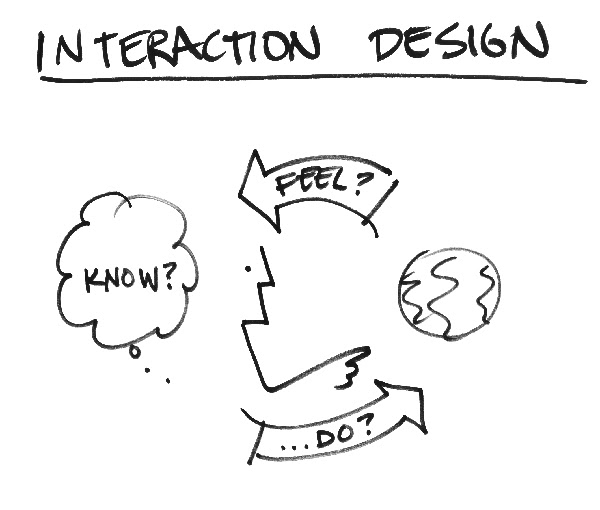
Principles of
Interaction Design


BEHAVIOUR / INFORMATION NEEDS / THE INTERACTION DESIGN PROCESS

Designing to meet and exceed user expectations.

- the practise of designing interactive products, environments,    systems and services.
- has an interest in form but main focus is behaviour.

Interaction Design and User Experience perspective:


----------------------------------------------------------------------------


OBJECT - BEHAVIOUR - SCENARIO


Research:


Understanding 'telepresence':

- a set of technologies which allow a person to feel as if they were present, to give the appearance of being present, or to have an effect, at a place other than their true location

- requires stimulation to the individuals senses

- may have the ability to affect the remote location

- user's position, movements, actions, voice, etc. may be sensed, transmitted and duplicated

- information can be travelling in both directions

Reflection:
The concepts behind interaction design would suggest to me that products that involve this would be more successful. I like the idea of creating a 'system' rather than just a singular product for the consumer. With today's consumer behaviours, for example. the reliance on technology and the instantaneous delivery of information to the user, these multifaceted systems prove to be beneficial to the user as well as contributing to increased productivity.


Friday, 5 August 2011

Week 2

Site visit: LifeTec

LifeTec is a not for profit organisation run to provide assistance and information for those in need, in order to improve an individuals quality of life. Throughout the visit I learnt a lot about assistive technologies and their importance in society. Jamie, our guest lecturer and occupational therapist, provided insight into the many challenges faced by individuals with a disability, whether it my minor or severe.

Device + System + Design = Assistive Technology

Assistive Technology includes:
- Home health care
- Aids & Equipment
- Aids to daily living

Assistive technology contributes as a means of enhancing an individuals functionality and essentially allowing them to perform a task they were previously unable to do on their own. It also helps to increase ease and safety to which a task can be performed.

A range of different technologies can be used in the development of assistive technologies, some of which include wi-fi, infra-red, bluetooth, Iphone/Ipad applications, GPS and the 3G network.

Examples of Assistive Technologies:

LifeTec: Phone with photo buttons and large scale buttons for the visually impaired. 

LifeTec: Hoist for moving physically disabled people, for example, from wheelchair to bed. This also assists with the Occupational Health and Safety for the Occupational Therapist.

LifeTec: Assisted cutting board for those with difficulties associated with their hands. 

Assistive systems have also been applied to other existing technologies. For example, need specific applications for iPhone and iPad (or Apps) have been developed for those with disabilities for ease of use, learning and general assistance in communication as well as in everyday life.

Examples...


Reflection:
The site visit to LifeTec fully opened up my way of thinking in terms of the project. For a product to be successful and beneficial it needs to be inclusive to those who are both fully abled and those with disabilities. The Occupational Therapists at LifeTec demonstrated effectively how simple tasks can become extremely difficult to those effected by disability, whether it be minor (eg. slight loss of sight) or severe (completely wheelchair bound). I was particularly interested in the computer software specifically designed to assist those who struggle with typing or using a mouse, a simple task performed daily that to us is just second nature. From a hardware device above your computer monitor, this software was able to recognise your eye movements and control the cursor, instead of using a mouse with your hand. I find this to be extremely interesting and beneficial, however, while it does have potential to be an awesome product, the technology still needs fine tuning and updating.

Overall, the site visit was inspiring.